★ 5-Star Rating on Google, 296 Burlington patients. In 2025, our patients who finished their full care plan cut their pain by more than half on average.
See if shockwave can end your elbow pain
It shows up when you need your grip
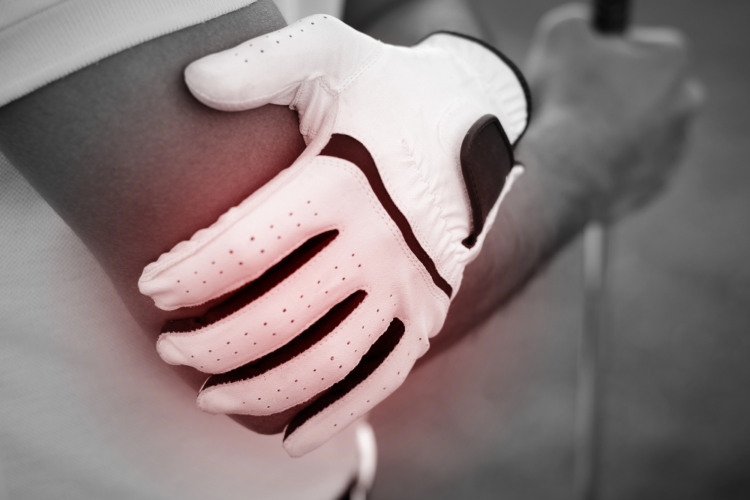
Carrying a suitcase. The third bag of mulch. The takeaway on the first tee after a week off. Golfer’s elbow announces itself on the inside of the elbow, right where the forearm muscles anchor, and it has a talent for picking the worst moment.
The name is misleading. Plenty of the people we treat for it have never kept a scorecard. It belongs to anyone who grips and pulls for a living or for fun: lifters, throwers, climbers, mechanics, and yes, golfers. What they share is a spot on the inner elbow that has been sore for months and a growing list of things they quietly avoid.
If that list has started running your week, keep reading.
Who we see with this in Burlington
Every town gives an injury its own flavor, and here it looks like this. A member at Alamance Country Club whose elbow lights up on shots off hardpan. A City Park pickleball regular whose forehand went from weapon to liability. A framer in Graham who feels it on every screw he drives overhead. Someone at the gym who loves deadlift day and has started dreading it. A grandmother in Elon who notices it most lifting the pan out of the oven.
Different lives, same tendon, same frustration: the thing you enjoy is the thing that hurts.
What you have probably already tried
There is a well-worn path to our door, and you are probably somewhere on it. It starts with ignoring it, because it will go away. Then the strap from the pharmacy. Then a stretch routine from YouTube, done faithfully for two weeks. Then pills before the round and regret after. For some, a cortisone shot that bought a good month or two before the ache moved back in.
Every step on that road makes sense early on, and early cases often do settle with simple care. What stalls is the elbow that has been sore past the three-month mark. By then the tendon is usually not inflamed in the way it was at the beginning, which is exactly why the anti-inflammatory playbook stops producing results.
Why it keeps coming back
There is a well-worn path to our door, and you are probably somewhere on it. It starts with ignoring it, because it will go away. Then the strap from the pharmacy. Then a stretch routine from YouTube, done faithfully for two weeks. Then pills before the round and regret after. For some, a cortisone shot that bought a good month or two before the ache moved back in.
Every step on that road makes sense early on, and early cases often do settle with simple care. What stalls is the elbow that has been sore past the three-month mark. By then the tendon is usually not inflamed in the way it was at the beginning, which is exactly why the anti-inflammatory playbook stops producing results.
What we do differently
The centerpiece is shockwave therapy, delivered with Storz equipment, the brand you find in sports medicine settings. In a few focused minutes, it sends repair signals into the exact tissue that went quiet, which is the step the strap, the stretches, and the injection never addressed.
Medial epicondylitis sits on the short list of conditions where shockwave has its deepest research base, particularly for cases past three months that have shrugged off basic care. And beyond the literature, we track our own results: in 2025, our patients who finished their full care plan cut their pain by more than half on average. Results vary and no outcome is guaranteed.
Around the shockwave sessions, your exam decides what else earns a place in the plan:
- Progressive strength work for the forearm, because tendon that is rebuilding gets stronger by being used well, not by being babied.
- Dry needling when knotted forearm flexors keep re-loading the sore anchor point.
- Chiropractic care when a stiff wrist, shoulder, or neck is quietly feeding extra load down the arm.
- Graston or K Laser when the soft tissue itself needs the help.
What your first visit looks like
Expect an exam and a straight answer, in that order.
We test the elbow, but we also test everything that loads it: grip strength, wrist motion, how your shoulder rotates, and if you golf, what your swing asks of your trail arm. Inner elbow pain can borrow symptoms from the neck or from the ulnar nerve, and the exam is how we make sure we are treating the right problem instead of the loudest one.
You leave knowing three things: what we found, whether our care fits it, and exactly what a plan would cost before you commit to a dollar of it. When the findings point somewhere we do not treat, we say that too, and we send you to the physicians and orthopedists we work alongside.
What a course of care looks like at Cardinal Chiropractic
A typical course is three to six shockwave visits, spaced about a week apart, wrapped inside the broader plan your exam calls for. Because shockwave is a cash service, the plan answers to your goals rather than to an insurance authorization.
| Option | Price |
|---|---|
| Single session | $125 |
| 4 Pack | $400 |
| 6 Pack | $600 |
Common questions
What does a session feel like? A rapid, firm pulsing against the inner elbow, strong enough to notice and brief enough to tolerate. Expect the area to feel worked afterward, the way a muscle does the day after training.
Do I have to stop playing or lifting? Rarely outright. We usually adjust volume and grip stress rather than banning the activity, and we ask you to go easy on the arm for a day or two after each session while the tissue responds.
Why didn’t the cortisone shot last? Because it treated inflammation, and by the chronic stage the main problem is worn tendon, not swelling. Quieting pain and rebuilding tissue are different goals. Our plan is aimed at the second one, which is why many people who are tired of repeat injections end up here.
Do I need an MRI before coming in? Usually not. A hands-on exam identifies most cases, and if yours shows something that genuinely needs imaging, we will tell you and point you to the right place rather than guessing.
When will I feel a difference? Some people notice a shift inside the first handful of visits. The deeper change tends to arrive over the weeks that follow, since tendon keeps remodeling after the sessions end. We cannot promise a date, and we will not pretend otherwise.
Where does insurance fit? The shockwave portion is cash, priced above. Pieces like the adjustment or rehab may run through your insurance depending on your plan. You will see the full cost picture in writing before anything begins.
Who should not do this? Shockwave has a strong safety record and real exclusions. A recent cortisone injection at the site, certain medications, an active infection, and a few other conditions rule it out. Screening for those is part of the exam, and we will be honest if you land on the wrong side of the list.
A quick gut check
This is probably your next step if the inner elbow has been sore for three months or more, the strap-stretch-pills routine has already had its chance, and you would rather rebuild the arm than keep renting relief a few weeks at a time.
We are probably not your clinic if the pain started last weekend, since fresh cases deserve a fair shot at settling on their own first. Or if you are hunting for the cheapest visit in town rather than the shortest route back. Or if you want something done to you with nothing asked of you, because the strength work is not a garnish, it is half the treatment.
Either way, the exam sorts it out, and we will tell you plainly which side you are on.
Proudly serving Burlington and the rest of Alamance County, including Graham, Mebane, Elon, and Gibsonville.