For people whose sciatica has started sending pain down the leg, and whose days now get planned around sitting, standing, and sleeping.
★ 5.0 on Google from Burlington patients. In 2025, Cardinal patients who completed their full care plan cut their pain by more than half on average.
When the sciatica pain starts to travel
It may have started as a sore low back. Now it runs through the buttock and down the back of the leg, sometimes past the knee and into the foot. The drive to Greensboro is something you brace for. You stand at the back of meetings, eat dinner standing at the counter, and sleep with a pillow between your knees. Putting on socks takes a plan. Some days the foot tingles or feels a little numb, and a cough or a sneeze can send a jolt down the leg.
If that has gone on for four weeks or longer, and rest, stretching, and pills have not turned it around, this page is for you.
Three kinds of leg pain we sort out
Sciatica is a description, not a diagnosis. It means pain along the path of the sciatic nerve. In Burlington we mostly see three causes behind it.
The disc. A disc in the low back bulges or tears and presses on a nerve root. Sitting, driving, and bending forward tend to make it worse. We see it in desk workers, truck and delivery drivers, trades workers who lift all day, and lifters who felt something on a deadlift.
The hip and buttock muscles. Tight, overworked muscles deep in the hip can irritate the nerve as it passes through. It often hurts more in the buttock than the leg, and it is common in golfers, runners, and anyone who sits on a hard seat for hours.
The narrowed opening. With age, the spaces the nerves pass through can narrow. The legs feel heavy or achy on longer walks and ease when you sit or lean on a shopping cart. We see it in active retirees whose walks keep getting shorter.
Many people have more than one of these. Each one calls for a different plan, which is why the exam comes first.
What you have probably tried
Leg pain from the back sends people down a long list. Days on the couch that helped until you got up. Hamstring stretches from a video that seemed to make the leg angrier. A heating pad, a new office chair, a new mattress. Ibuprofen, a muscle relaxer, a steroid dose pack. A few weeks of physical therapy with a printed handout. For some, an epidural injection that bought a good month or two.
None of those were wrong. For a first flare, rest and time often do the job. The trouble starts when the leg pain will not leave, or when it keeps coming back every few months.
Why it keeps coming back
Most sciatica has a mechanical cause. Something is putting pressure or strain on a nerve, and the way you sit, bend, and lift keeps loading the same spot. Pills, steroid packs, and injections are designed to quiet the inflammation, and that can feel like a real fix for a while. They do not change the pressure on the nerve or the habits that load it, so when life gets busy again, so does the leg.
A plan that lasts has to do two things. Calm the irritated nerve, and change what keeps irritating it.
How we build a sciatica plan
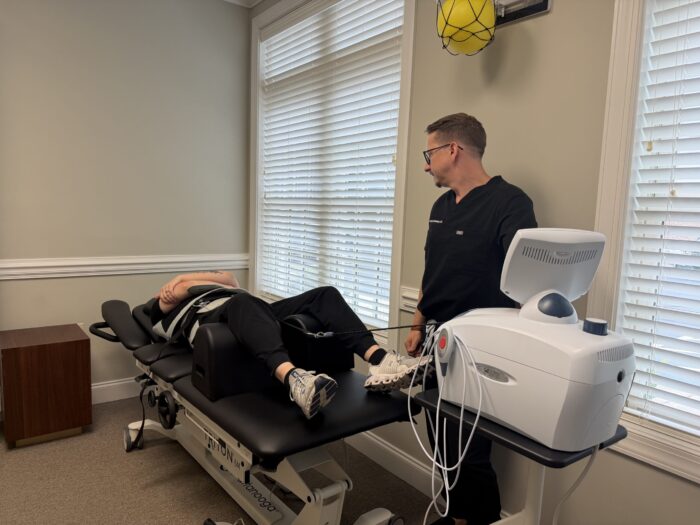
For disc-related leg pain, the plan often centers on spinal decompression on our Chattanooga Triton DTS table. It is a slow, computer-controlled stretch and release cycle aimed at lowering pressure inside the involved disc and easing the strain on the nerve. Research on decompression for disc-related leg pain is encouraging, and it tends to do best as one part of a complete plan rather than on its own. Around it, depending on your exam, you may get:
- Chiropractic care, including gentle techniques like flexion-distraction that suit an irritated disc.
- Directional exercises. Specific movements that, in many disc cases, help draw the pain out of the leg and back toward the spine. You do these at home between visits.
- K Laser to help calm irritated tissue around the nerve.
- Core and hip strength work, so your back is better supported when you sit, bend, and lift.
For leg pain driven by the hip and buttock muscles, decompression is usually not the right tool. The plan leans on chiropractic care, shockwave therapy, and dry needling for the deep muscles of the hip, and strength work instead.
For a narrowed opening, decompression may help some people, paired with walking practice and hip strength. For some, this fits inside our Non Surgical Joint Replacement program, a structured care plan that is not a substitute for surgery that is medically necessary.
Get emergency care today, not an appointment, if your leg pain comes with new or worsening weakness in the leg or foot, numbness in the groin or inner thighs, or new trouble controlling your bladder or bowels. These can be signs of a problem that needs immediate medical care.
Your first visit
We start by finding out which kind of leg pain you have. We ask where the pain travels, what makes it better or worse, and what you have already tried. Then we test your reflexes, strength, and sensation, check how your back responds to a few repeated movements, and look at your hips. If you have an MRI or X-rays, bring them. If your exam points to imaging, we will tell you.
Then you get our read in plain language. If our care fits, you get a written plan with the visit count and the cost before your first treatment. If your case needs a medical or surgical opinion first, we tell you that day and help you get there. We work alongside local physicians and surgeons, not around them.
What a sciatica plan costs
When decompression fits, a typical course is two to three visits a week for four to eight weeks. Most of those visits pair decompression with your chiropractic adjustment and exercise work, and many add K Laser.
| Option | Decompression | Decompression with K Laser |
|---|---|---|
| Single visit | $75 | $120 |
| 6 Pack | $420 | $660 |
| 12 Pack (the most common plan) | $780 | $1,260 |
Decompression and K Laser are cash services at these prices, which lets your plan follow your spine and your goals instead of an insurance approval. The chiropractic care and rehab parts of your visit may run through your insurance depending on your plan. Packages do not expire, and any prepaid visit you do not use is refunded.
Not every sciatica case needs decompression. If yours is driven by the hip muscles, your plan may be mostly chiropractic care, dry needling, and exercise. Your written plan shows every number before you start.
Sciatica questions, answered
How do I know if it is a disc or something else? How the pain behaves gives clues. Pain that runs below the knee and gets worse with sitting and bending often points to a disc. Pain that stays mostly in the buttock leans toward the hip muscles. Legs that tire on walks and feel better sitting lean toward narrowing. The exam is how we tell, and many people have a mix.
Do I need an MRI before I come in? No. Many people come in without one. If your history or exam suggests imaging would change the plan, we will recommend it. If you already have one, bring it and we will go through it with you.
Should I keep stretching? Some stretches help, and some can irritate an angry nerve, especially hard hamstring stretches when a disc is involved. We will show you which movements help your pattern and which to set aside for now.
Can a chiropractor help a herniated disc? Many people with a herniated disc improve with conservative care, and research supports trying a complete conservative plan before injections or surgery in many cases. Gentle chiropractic techniques, decompression, and the right exercises are often part of that plan. We will tell you honestly if your case needs more than we offer.
I already had an injection, or I was told I need surgery. Should I still come in? Many people come to us after an injection has worn off or while they are weighing surgery. We will review your history and imaging and tell you whether our care is a good fit. If surgery is the right call, we will say so and help you find the right surgeon.
How long until I feel better? Some people notice less leg pain or easier sitting within the first few visits. Meaningful change usually builds over four to eight weeks, because nerve and disc tissue settle slowly. We re-check as we go.
Can I keep working, golfing, or lifting? Usually, with changes. We would rather keep you moving with a smarter plan than shut you down. Your exam decides what to adjust for now, like how long you sit at a stretch or what you lift.
Does decompression hurt? Most people describe a slow, mild stretch, and many find it relaxing. You stay fully clothed, and we adjust the settings to your comfort.
Will insurance cover any of this? Decompression and K Laser are cash at the prices above. Chiropractic visits and rehab may be covered depending on your plan, and we spell out the split before you commit.
A few months from now
When a sciatica plan goes well, people notice the ordinary things first. They sit through a whole movie. They put on socks without a plan. The drive to work stops being something to brace for. Then the bigger things return: a full round of golf, a full shift without a break to stretch, a night of sleep that does not start with finding the one position that works.
When leg pain is left to drift, the changes are quiet too. Car trips get shorter, the gym gets skipped, and the foot that tingles now and then starts to tingle more often.
“I came in with lower back and hip pain that radiated down to my ankle. The treatment program that Dr. Andy provided for my case kick-started my own active lifestyle… I am not fully pain free, but getting there.” Chris R., Google review
Is this you?
Likely a good fit if:
- Pain has traveled from your low back into your leg for four weeks or more.
- Rest, pills, a steroid pack, therapy, or an injection helped for a while but did not hold.
- You want to get back to sitting, driving, working, sleeping, and playing without planning around your back.
- You will do the home exercises between visits.
Probably not the right clinic if:
- Your back went out this week. Gentle movement and a little time come first. If the leg pain is still there in a couple of weeks, call us.
- You have new leg weakness, numbness in the groin, or bladder or bowel changes. Go to the emergency room.
- You are looking for the cheapest visit in town rather than a plan that gets you somewhere.
- You want a quick fix with no exercise. The home work is what keeps the leg pain from coming back.
We screen every patient at the exam and will tell you if we are not the right fit.
Patients come to us from across Alamance County, including Graham, Mebane, Elon, and Gibsonville.
Online booking is open around the clock. You can also call 336-270-3050. 1710 Westbrook Ave, Burlington, NC 27215.