For active adults whose knee pain has started deciding how far they walk, how low they squat, and whether they play today.
★ 5.0 on Google from 299 Burlington patients. In 2025, our shockwave patients reported an average pain drop from 6.4 to 3.3 out of 10 over their care plan.
When your knee pain starts making the plans
The stairs at home have turned into a one-at-a-time thing. Getting out of a low chair takes a hand on the armrest. You warm up longer before pickleball and ice longer after. Kneeling in the garden is out, and deep squats at the gym stopped a while ago. Some days it aches just below the kneecap. Other days it is a deep, stiff ache inside the joint that takes a few minutes to loosen up in the morning.
You still show up. You have just been bargaining with your knee to do it. If that has been going on for three months or more, and rest, a brace, or a round of therapy has not changed the pattern, keep reading.
The two knees we see most in Burlington
Two kinds of knee come through our door most weeks.
The first is the tendon knee. Pickleball players at City Park who feel it on quick stops and lunges. Runners on the Haw River Trail who feel it on the downhills. Lifters who feel it at the bottom of a squat. The pain sits just below or around the kneecap, and it tends to flare after activity instead of during it.
The second is the worn knee. Golfers who feel it by the back nine. Walkers, gardeners, and grandparents who want to get down on the floor and back up again. The ache sits deeper, it is stiff in the morning, and someone may have already used the word arthritis.
Plenty of knees are a little of both. Your exam sorts out which one you have.
What has not worked so far
Knee pain sends people down a familiar list. A sleeve or a brace. Ibuprofen before you play and an ice pack after. Quad sets and straight leg raises from a handout. A few weeks off that ended the moment you went back. A cortisone or gel shot that bought a few good months. For the worn knee, sometimes a surgeon who said to come back when it gets bad enough.
Those were all reasonable steps. They tend to calm the knee down without changing what keeps overloading it, which is why the relief fades once life picks back up.
Why the knee keeps taking the blame
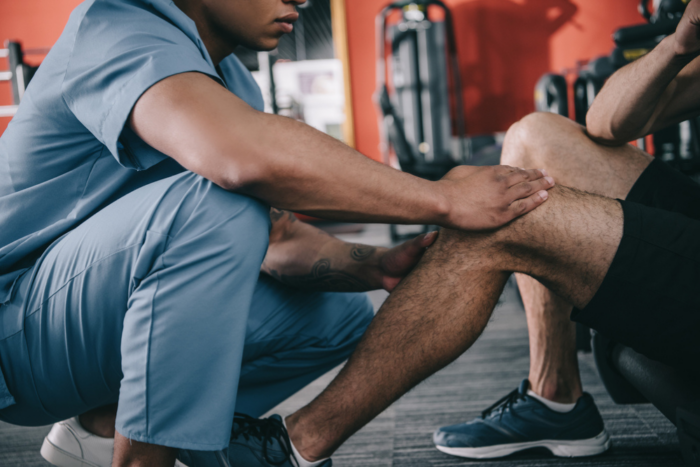
The knee sits between the hip and the ankle, and it pays for problems at both ends. A weak hip lets the knee drift inward on every step and landing. A stiff ankle makes the knee bend more than it should on stairs and squats. A low back problem can even send pain down to the knee. Treat only the knee and those drivers keep doing their damage.
Inside the knee, two things tend to stall. A patellar tendon that has been irritated for months stops repairing itself the way it did at the start. And in an arthritic knee, the tendons and tissue around the joint get sore and tight from guarding it. Both tend to respond better to a plan that works on the tissue and the mechanics together than to rest alone.
How our knee pain plans are built
For most stubborn knee cases, the plan starts with shockwave. Our Storz shockwave sends pressure waves into the sore tendon and tissue around the knee, aiming to help restart repair that has stalled. See how shockwave works.
For tendon pain below the kneecap, chronic patellar tendinopathy, often called jumper’s knee, is one of the established uses for shockwave, with the best results in cases that have hurt for more than three months. For arthritic knees, research on shockwave is emerging and promising. Studies on K Laser for knee arthritis also report less pain and better function for many patients, so your plan may use one, the other, or both. Around those, depending on your exam, you may get:
- Chiropractic care for the hip, knee, and ankle, so the joints above and below share the load again.
- Quad and glute strength work. This is the part research backs most for knee arthritis, and it is what helps a rebuilding tendon hold up.
- Dry needling for the tight muscles that pull on the knee.
- Movement checks on squats, stairs, and landings, so we can see where the knee is taking extra load.
For worn knees, these pieces come together in our Non Surgical Joint Replacement program, a structured care plan that may help some people delay or avoid a knee replacement. It does not regrow cartilage, and it is not a substitute for surgery that is medically necessary.
“Dr. Andy is very caring and recommended I do the dry needling for my severe knee pain and it has definitely been very helpful in relieving the pain!” Danny K., Google review
Your first visit
We start by finding out which knee you have. Tendon pain, arthritis, a meniscus problem, a kneecap that tracks poorly, and pain sent down from the hip or low back can all show up in the same spot. We test the knee, watch you squat, step, and balance on one leg, and check your hip, ankle, and low back. If you have X-rays or an MRI, bring them.
Then you get our read in plain language. If our care fits, you get a written plan with the visit count and the cost before your first treatment. If the exam shows a knee that locks, gives way badly, or needs an orthopedic look, we tell you that day and help you get there.
What a knee plan costs
A typical shockwave course is four to six sessions about a week apart. Arthritic knees often start with six to eight, and a stubborn patellar tendon sometimes needs a longer course. Many knee plans treat two areas, because the hip or ankle is part of the problem.
| Option | Price |
|---|---|
| Shockwave, single session | $125 |
| Shockwave 6 Pack (one area) | $600 |
| Shockwave 2-Region 6 Pack (knee plus hip, or knee plus ankle) | $900 |
| K Laser, per session | $45 |
Shockwave and K Laser are cash services at these prices, which lets your plan follow your goals instead of an insurance approval. Chiropractic care and rehab may run through your insurance depending on your plan. Your written plan shows every number before you start.
Knee pain questions, answered
Is my knee pain arthritis or something else? How it feels only tells part of the story. Pain right below the kneecap after activity leans toward the tendon. A deep, stiff ache that is worst in the morning or after sitting leans toward arthritis. Many knees have both, and the exam is how we tell.
Can shockwave help knee arthritis? Research on shockwave for knee arthritis is emerging, with promising drops in pain and better function that often last several months after a series. It does not rebuild cartilage. It is aimed at the sore tissue around the joint, and it works as one part of a full plan.
What about jumper’s knee? Long-standing patellar tendon pain is one of the more established uses for shockwave, especially when it is paired with progressive strength work. Most plans run three to six weekly sessions, and some stubborn cases need more.
I was told I need a knee replacement. Should I still come in? Many people come to us while they are weighing that decision. A complete conservative plan is a recognized first step for many people with knee arthritis, and some are able to put off surgery. We will not promise that, and if your knee is past what conservative care can help, we will tell you.
What if I have a meniscus tear? Lots of people have meniscus changes on an MRI, and not all of them are the source of the pain. If your knee locks, catches, or will not straighten, that needs an orthopedic opinion, and we will help you get one.
Does treatment hurt? Shockwave feels like a firm, rapid tapping. Near the kneecap it can be sharp for a minute, and we adjust the intensity as we go. K Laser feels like gentle warmth. Some soreness for a day or two after shockwave is normal.
Can I keep playing pickleball while I am in care? Often, yes, with some changes. We would rather keep you moving with a smarter plan than shut you down completely. Your exam decides how much is too much right now.
Who should not have shockwave? We screen for a recent cortisone shot in the knee, blood thinners, active infection, a recent fracture, and certain implanted devices. If shockwave is not right for you, we will tell you and look at other options.
Will insurance pay for any of this? Shockwave and K Laser are cash at the prices above. Chiropractic visits and rehab may be covered depending on your plan, and we spell out the split before you commit.
A year from now
When a knee plan goes well, patients usually notice the small things first. The stairs go back to one foot after the other. They stop reaching for the armrest. Then the bigger things come back: a full round walked instead of ridden, a morning of pickleball without an ice pack waiting at home, a garden bed planted from the ground.
When a knee is left to drift, the changes are just as quiet. The walks get shorter, the brace becomes permanent, and decisions about the next few years start getting made around one joint.
Is this you?
Likely a good fit if:
- Your knee has bothered you for three months or more.
- Rest, a brace, a shot, or physical therapy helped for a while but did not hold.
- You want to keep playing, walking, training, or working on your feet.
- You will do the strength work at home between visits.
Probably not the right clinic if:
- You twisted your knee this week. Ice, rest, and time come first. If it is not better in a couple of weeks, call us.
- Your knee swelled up fast after an injury, will not hold your weight, or locks. Get it checked by urgent care or an orthopedic provider first.
- You are looking for the cheapest visit in town rather than a plan that gets you somewhere.
- You want something done to you with no exercise. Strength is the part of this that lasts.
We screen at the exam and will tell you if we are not the right fit.
Patients come to us from across Alamance County, including Graham, Mebane, Elon, and Gibsonville.
Online booking is open around the clock. You can also call 336-270-3050. 1710 Westbrook Ave, Burlington, NC 27215.